



Trust Fund Recovery Penalty
That Stops IRS Personal Liability and Protects What You've Worked For
$0M+
Discover how much tax debt forgiveness you qualify for.
What Is the Trust Fund Recovery Penalty?
The Trust Fund Recovery Penalty (TFRP) is one of the most serious actions the IRS can take against a business owner. When a business fails to remit withheld employee taxes to the IRS, the agency can bypass the business entirely and hold responsible individuals personally liable for the unpaid amount.
This means your personal bank accounts, home, and assets are all on the table. The TFRP is not limited to business owners alone. Any person deemed a “responsible party” who had authority over company finances can be assessed this penalty.
Why Do People Need Trust Fund Recovery Penalty Help?
Many business owners don’t realize they are personally at risk until the IRS sends a formal assessment notice. By that point, collection action can begin almost immediately against personal assets.
The IRS has the authority to:
- Assess the TFRP against multiple individuals within the same business
- File personal federal tax liens against your home and property
- Levy your personal bank accounts and wages
Trust Fund Recovery Penalty representation exists to challenge the assessment, negotiate the liability, and protect your personal financial future.
Common Problems Trust Fund Recovery Penalty Resolution Handles
The TFRP creates a wide range of serious challenges for business owners and executives. Disputes over who qualifies as a “responsible party” are among the most common issues we handle, as the IRS often casts a wide net. Incorrect penalty assessments are also frequent, particularly in cases involving multiple owners or officers where liability is shared. Personal asset levies and liens resulting from a TFRP assessment can devastate personal finances overnight. Our attorneys fight to dispute, reduce, and resolve TFRP assessments before they cause irreversible damage.
An Example of Trust Fund Recovery Penalty Resolution
Consider a restaurant owner whose business fell behind on payroll tax deposits during a difficult stretch. The IRS assessed a Trust Fund Recovery Penalty of $95,000 directly against the owner personally after the business closed. With a lien filed against their home and a levy notice on their personal bank account, the situation felt hopeless. A Tax Law Advocates attorney challenged the responsible party designation, gathered financial documentation, and negotiated a resolution that significantly reduced the personal liability and released the bank levy before funds were seized.
Who Is Eligible for Trust Fund Recovery Penalty Relief in 2026?
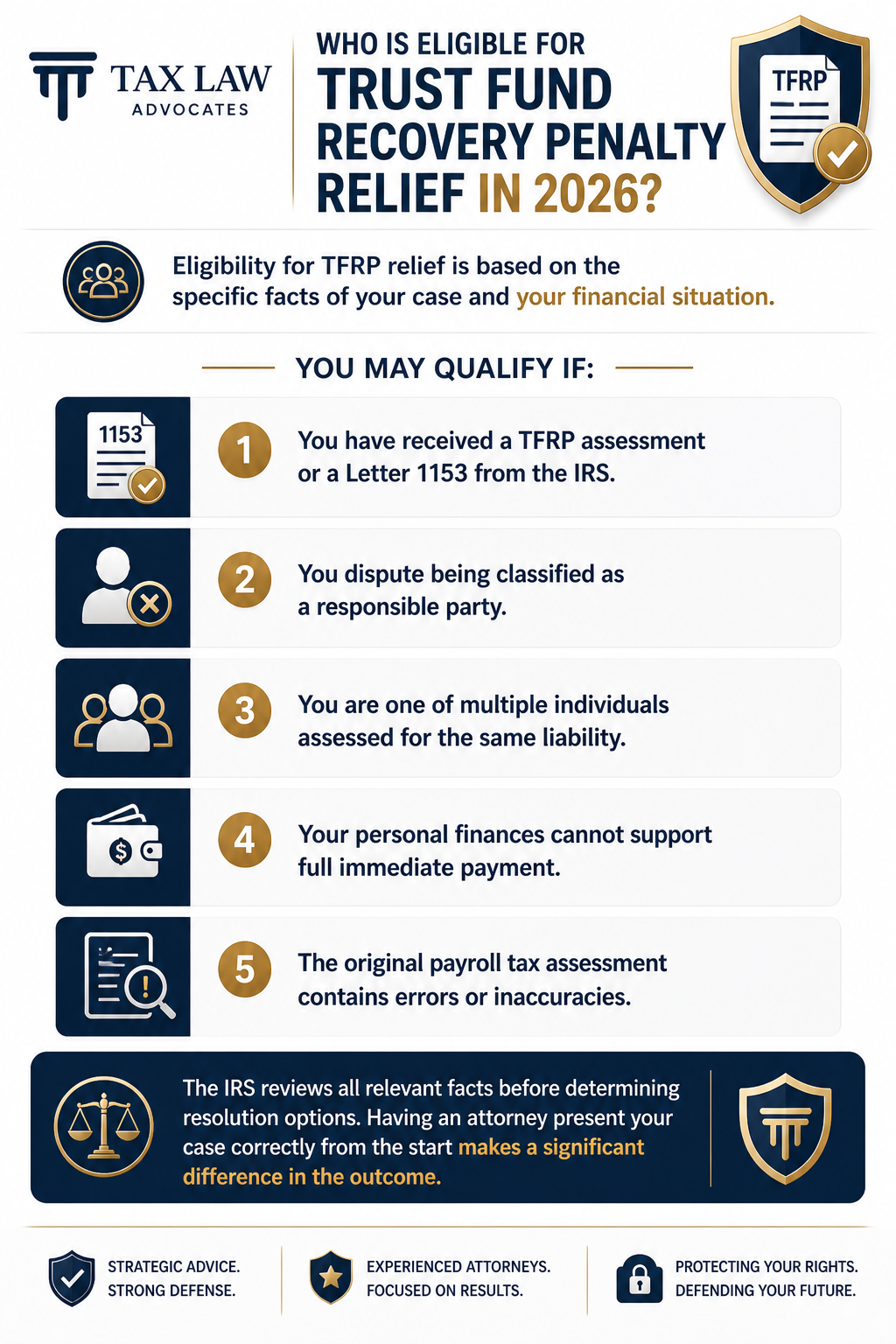
Eligibility for TFRP relief is based on the specific facts of your case and your financial situation.
You may qualify if:
- You have received a TFRP assessment or a Letter 1153 from the IRS
- You dispute being classified as a responsible party
- You are one of multiple individuals assessed for the same liability
- Your personal finances cannot support full immediate payment
- The original payroll tax assessment contains errors or inaccuracies
The IRS reviews all relevant facts before determining resolution options. Having an attorney present your case correctly from the start makes a significant difference in the outcome.
The Truth About Trust Fund Recovery Penalty Relief: Pros, Cons & What the IRS Says
The greatest advantage of professional TFRP representation is the ability to challenge the assessment itself before it becomes final. An attorney can dispute the responsible party designation, present financial evidence, and negotiate on your behalf in ways that an individual simply cannot do alone. That said, TFRP relief requires acting quickly. Once the assessment becomes final and collection begins, your options narrow significantly. The IRS acknowledges appeals rights and resolution programs for TFRP cases, but strict deadlines apply and proper documentation is non-negotiable.
What Trust Fund Recovery Penalty Relief Options Are Available to Me?
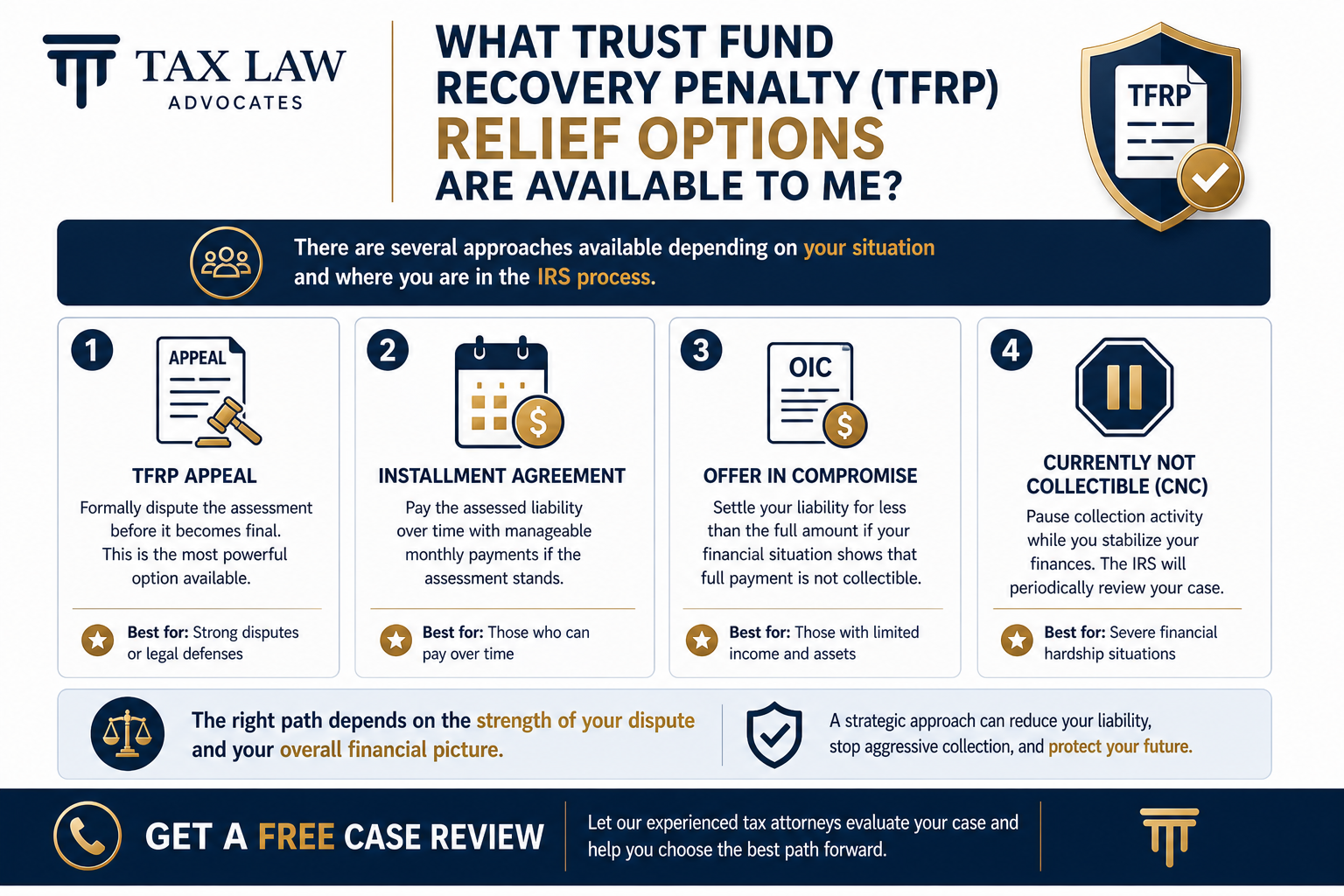
There are several approaches available depending on your situation and where you are in the IRS process.
A TFRP Appeal allows you to formally dispute the assessment before it becomes final, which is the most powerful option available. An Installment Agreement can be arranged to pay the assessed liability over time if the assessment stands. An Offer in Compromise may be an option if your financial situation demonstrates that full payment is not collectible. In some cases, Currently Not Collectible status can pause collection activity while you stabilize your finances.
The right path depends on the strength of your dispute and your overall financial picture.
How to Apply for Trust Fund Recovery Penalty Relief in 2026?
Resolving a TFRP assessment requires more than just responding to an IRS notice. You will need to:
- Request a Collection Due Process hearing or file a formal appeal
- Gather documentation proving your role and financial authority within the business
- Complete IRS financial disclosure forms if pursuing a payment resolution
- Submit a properly structured response within IRS deadlines
Missing a deadline or submitting incomplete information can eliminate your right to appeal entirely.
Why Work With a Tax Attorney for Trust Fund Recovery Penalty?
The Trust Fund Recovery Penalty carries personal consequences that go far beyond the business. Your home, savings, and financial future are at risk. Working with a tax attorney gives you:
- Legal representation to dispute the responsible party designation
- Protection of personal assets from IRS collection action
- Expert negotiation to reduce or settle the assessed liability
- Guidance through the appeals process with strict IRS deadlines
Tax Law Advocates puts licensed attorneys on your case from day one. When your personal finances are on the line, you need more than a tax preparer. You need a legal advocate.
Why Tax Law Advocates
Tax Attorney: David Cho
Real Client
Scenarios
One client came to us facing wage garnishment while struggling to cover basic living expenses. After reviewing their financials, we positioned their case for hardship status, stopping collections.
Another client believed they had no options. By restructuring their financial presentation, we demonstrated eligibility for relief and prevented enforcement actions.
In a third case, we combined immediate protection with a long-term resolution plan, giving the client both relief and stability.
Meet Your Lead Tax Attorney and Enrolled Agent for IRS Debt Relief & Tax Resolution You Can Trust
David Cho
David Cho
Scott Mullerleile
EA with 12+ years in tax resolution and a background in collections. Scott has successfully handled hundreds of cases, including accepted Offers in Compromise and representation before Revenue Officers, audits, and appeals.
Our IRS Tax Relief Results by the Numbers
Proven results helping clients resolve IRS and state tax debt nationwide.
$0M+
Tax Debt Resolved for Clients
0K+
Clients served
0%
Handled by Tax Attorneys
0%
Cases Successfully Resolved
24hr
Average Case Action Time
0
Years of experience
Tax Law Advocates Client Success Stories
Jonnel Bolotano with Tax Law Advocates was amazing to work with. Even though I didn’t initially start my case with him, he stepped in, took charge, and stayed on top of everything from that point forward.
ItzMiBaebii
If I could give Tax Law Advocates more than 5 stars, I absolutely would. Jamie and Scott were my dream team, steady, sharp, and on top of every detail. I came in with a heavy tax burden that felt like it would follow me forever...
Rebecca Ingram
Jesse Moreno my tax lawyer did a wonderful job on my case. She was very patient kind and professional, and resolution that I received was better than I expected! Thank you Jesse for representing me!
Debbie Kern
FAQ
What are tax resolution services?
They are professional services that help resolve tax debt through negotiation and IRS programs.
Can tax resolution reduce my debt?
Yes, in some cases through programs like Offer in Compromise.
Do I qualify for tax relief?
It depends on your income, assets, and financial hardship.
How long does the process take?
It varies from weeks to several months depending on the case.
Will the IRS stop collections immediately?
In some cases, actions can be paused once representation begins.
Do I need a tax attorney?
It’s highly recommended for complex or high-value cases.
Can penalties be removed?
Yes, through penalty abatement if you qualify.
Is this available nationwide?
Yes, services are available in all 50 states.
What if I can’t pay anything?
You may qualify for hardship status.
Is the consultation free?
Yes, initial case reviews are free.
