



IRS Offer in Compromise

Settle Your Tax Debt for Less Than You Owe

$0M+

Tax Debt Resolved

Discover how much tax debt forgiveness you qualify for.

Your Name(Required)

If you’re overwhelmed by IRS debt and feel like there’s no way out, you’re not alone—and more importantly, you may not have to pay the full amount. An IRS Offer in Compromise (OIC) gives qualified taxpayers the opportunity to legally settle their tax debt for less than what they owe. But the process is complex, highly scrutinized, and often denied without the right strategy. At Tax Law Advocates, you work directly with experienced tax attorneys—not call centers—who know how to position your case for approval.

Homeowners Qualifying for IRS Offer in Compromise Tax Settlement

What is an Offer in Compromise?

An Offer in Compromise is a formal agreement with the Internal Revenue Service that allows you to settle your tax debt for less than the full amount owed.

In simple terms, it’s the IRS acknowledging that based on your financial situation, collecting the full balance isn’t realistic. Instead of forcing payments that would create financial hardship, they may accept a reduced amount as full settlement.

However, this is not a “discount program.” The IRS carefully evaluates your income, expenses, assets, and future earning potential before approving any offer.

What is the OIC Acceptance Rate?

Here’s a clean, updated 2026-based version using the most recent available IRS data trends (latest published dataset is typically 2023–2024, but we position it correctly for 2025 without risking accuracy or compliance).  Here’s the most recent IRS-backed data:

  • In FY 2024, the IRS received 33,591 OIC applications and accepted 7,199.
  • That puts the acceptance rate at roughly 21% — about 1 out of every 5 applications being approved.

The IRS accepts only a small percentage of Offer in Compromise applications, which is why strategic preparation and proper financial analysis matter.

Tax attorney reviewing IRS Offer in Compromise eligibility and case details on tablet

What is the OIC Acceptance Rate?

The IRS continues to approve a meaningful number of Offers in Compromise each year—but approval is still highly selective.

Based on the most recent IRS data available leading into 2025, the IRS accepted approximately 20,000–23,000 Offers in Compromise annually, out of roughly 45,000–55,000 applications submitted. That puts the acceptance rate at around 35%–45%. In those same recent reporting years, the IRS collected over $200 million annually through accepted Offers in Compromise, with average settlement amounts generally falling between $9,000–$14,000, depending on each taxpayer’s financial situation. What this means for you:

  • More than half of applications are still rejected
  • Many denials happen due to incorrect financial reporting or weak case positioning
  • The difference between approval and rejection often comes down to how the case is structured and presented

The bottom line—this program works, but it’s not automatic. A properly built case dramatically increases your chances of approval.

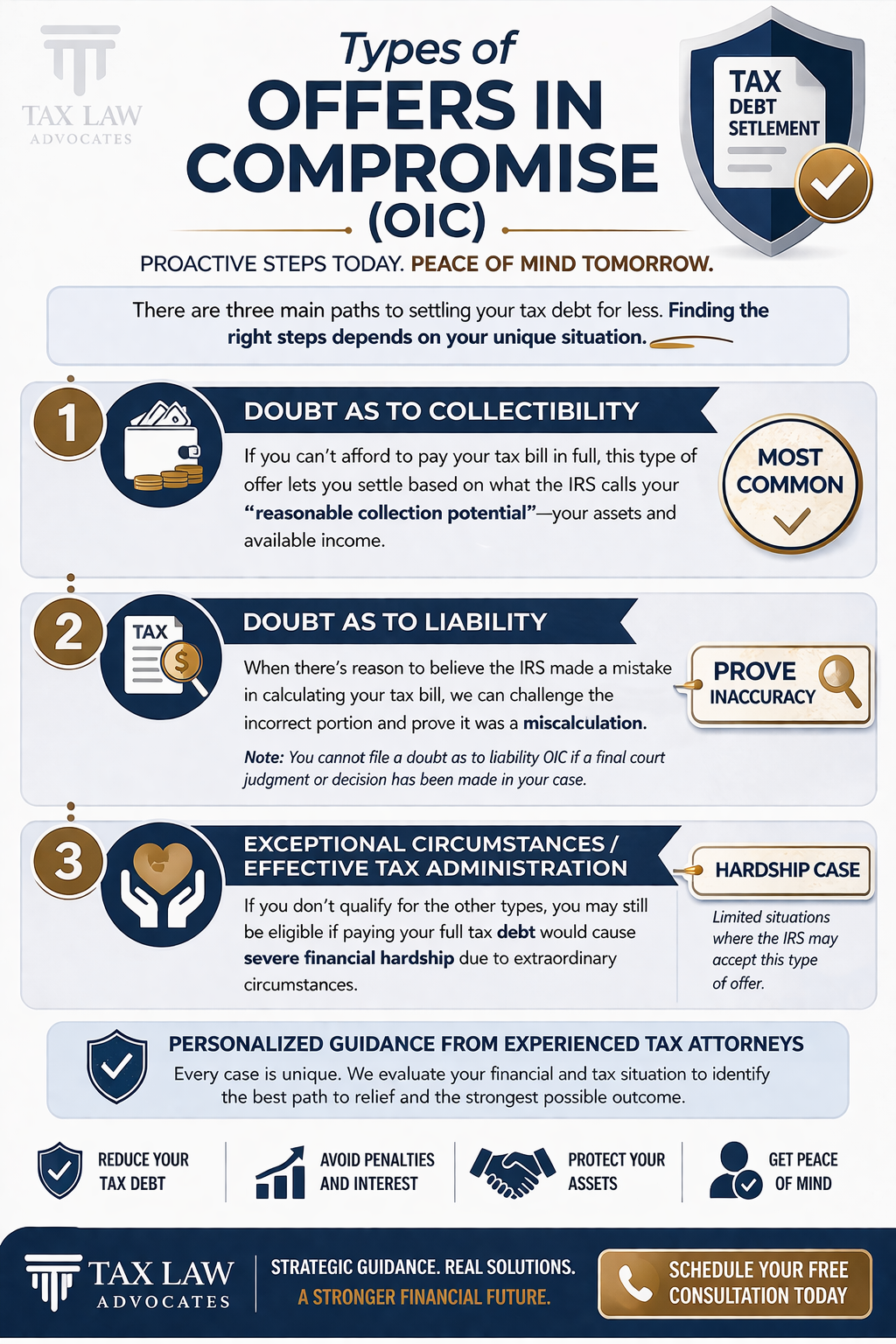
Types of Offers in Compromise

There are three primary types of OIC, and choosing the right one is critical to success.

The most common is Doubt as to Collectibility, where you prove that you simply cannot afford to pay the full tax debt.

Another is Doubt as to Liability, used when there is a legitimate dispute about whether the tax debt is correct in the first place.

The third is Effective Tax Administration, which applies when paying the full amount would create significant financial hardship—even if technically you could pay.

Each type requires a different legal approach and supporting documentation.

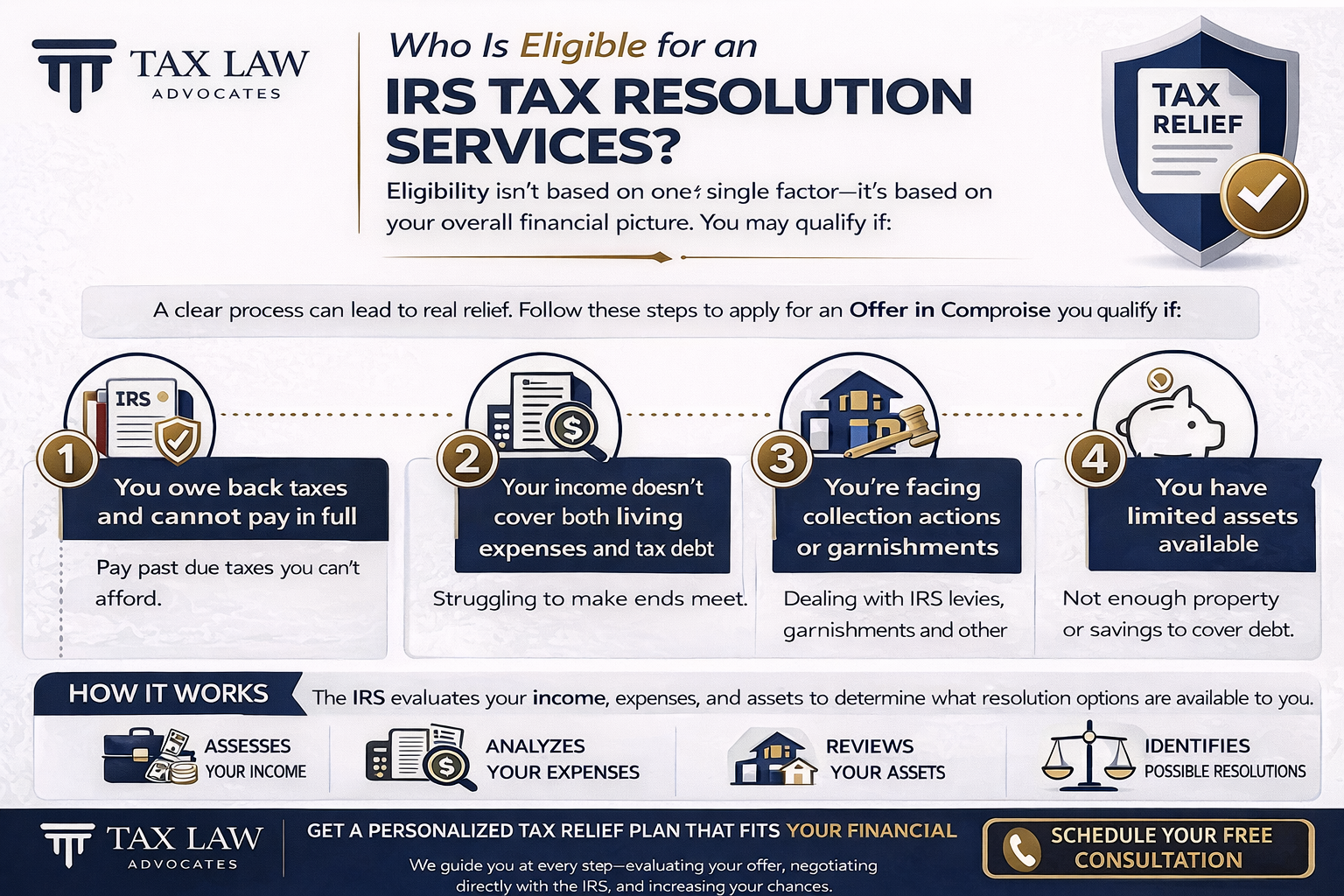
Who Is Eligible for IRS Tax Resolution Services in 2026?

Eligibility isn’t based on one single factor—it’s based on your overall financial picture

You may qualify if:

  • You owe back taxes and cannot pay in full
  • Your income doesn’t cover both living expenses and tax debt
  • You’re facing collection actions like levies or garnishments
  • You have limited assets available

The IRS evaluates your income, expenses, and assets to determine what resolution options are available to you.

The key is proper documentation and strategic presentation—this is where many people fail without professional help.

An Example of an Offer in Compromise

Let’s say you owe $20,000 in back taxes, but after reviewing your financial situation, it becomes clear that you can realistically only afford $6,000.

Instead of forcing payments you can’t sustain, the IRS may accept that $6,000 as full settlement—if the case is properly presented and justified.

The key is demonstrating:

  • Limited disposable income
  • Necessary living expenses
  • Lack of liquid assets

This is where most DIY applications fail—they don’t tell the financial story correctly.

Who is Eligible for the IRS Hardship Program?

Eligibility comes down to one core question:

Can you pay your tax debt and still afford your basic living expenses?

If the answer is no, you may qualify.

The IRS evaluates your situation using standardized financial guidelines. They look at your income, necessary expenses, and assets to determine if paying the debt would create a genuine hardship.

Generally, you may qualify if:

  • Your income is limited or inconsistent
  • Your essential expenses consume most of your earnings
  • You don’t have significant assets that can be liquidated
  • Paying the IRS would impact your ability to maintain basic living standards

But eligibility alone doesn’t guarantee approval—documentation and presentation are everything.

How Much Should the Offer in Compromise Be?

This is one of the most misunderstood parts of the process. The IRS calculates your offer based on something called your Reasonable Collection Potential (RCP)This includes:

  • Your monthly disposable income
  • The value of your assets
  • Future earning potential

The offer amount must reflect what the IRS believes it can reasonably collect from you over time. Offer too low, and it gets rejected. Offer too high, and you overpay unnecessarily. This is where professional analysis makes a significant difference.

IRS Offer in Compromise (OIC) Application Tips

Submitting an Offer in Compromise isn’t just paperwork, it’s a legal and financial presentation. Successful applications typically include:

  • Complete and accurate financial disclosure
  • Proper valuation of assets
  • Strategic positioning of expenses
  • Supporting documentation that aligns with IRS standards

Many applications fail not because the person doesn’t qualify, but because the case wasn’t structured correctly.

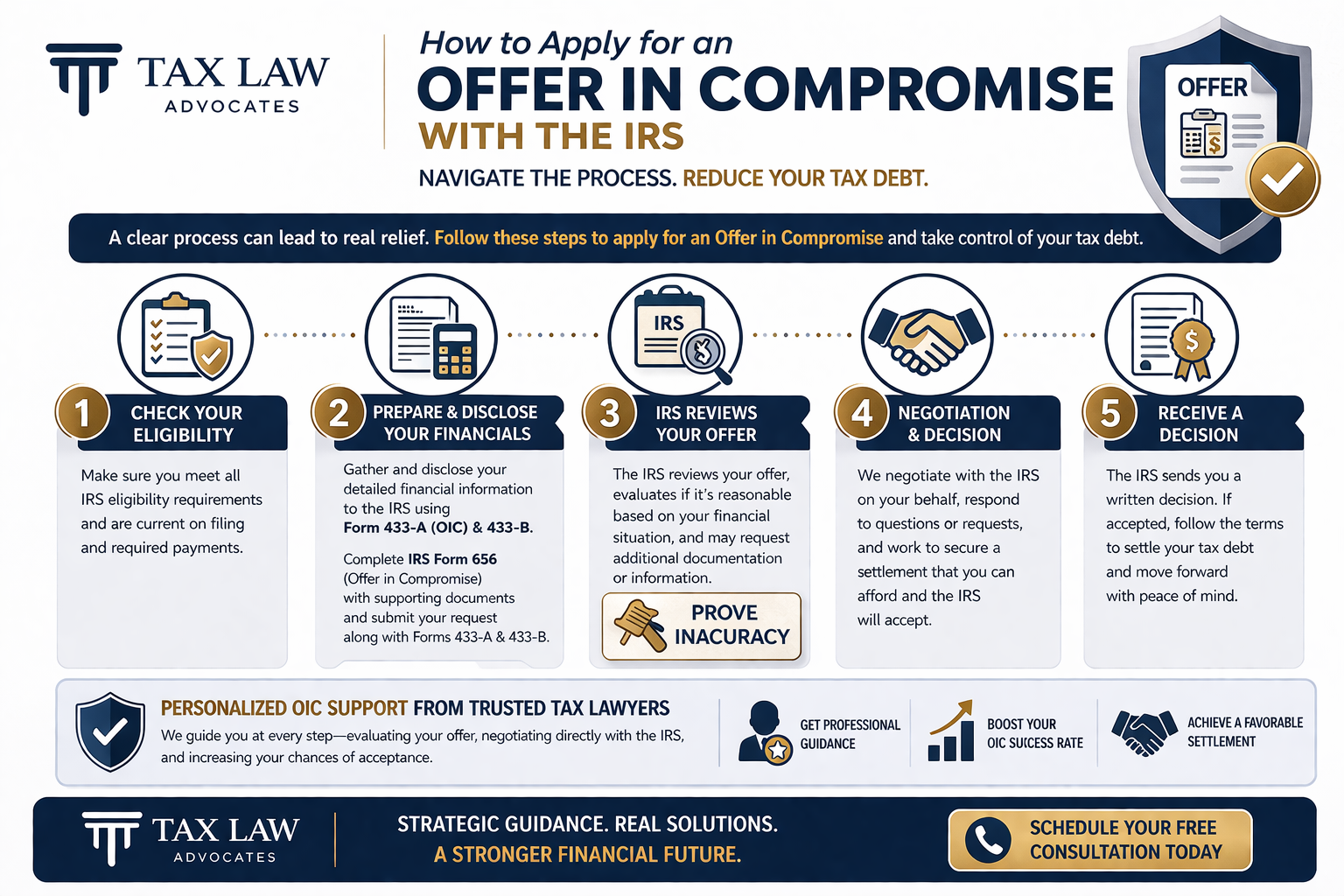
How to Apply for an Offer in Compromise with the IRS

The application process involves submitting detailed financial forms along with your proposed settlement amount.

This includes:

  • A full financial disclosure
  • Supporting documentation
  • Application fees (unless qualified for low-income exemption)

After submission, the IRS may take months to review the case, during which they may request additional documentation or clarification.

Having representation during this stage is critical, especially when communicating with IRS agents.

Why Work With a Tax Attorney for an Offer in Compromise?

An Offer in Compromise is not just a financial process, it’s a legal negotiation. Working with a tax attorney gives you:

  • Legal representation when dealing with the IRS
  • Strategic case development based on tax law
  • Protection from costly mistakes or misstatements
  • Direct negotiation with IRS officers

Most importantly, it ensures your case is presented in the strongest possible way.

Why Tax Law Advocates

At Tax Law Advocates, we don’t believe in one-size-fits-all solutions.

We provide:

  • Attorney-led case strategy
  • Customized financial analysis using proprietary tools
  • Transparent communication with no hidden tactics
  • Nationwide representation
  • Proven success in IRS negotiations

Our focus is simple—get you the best possible outcome based on your real financial situation.

Tax Attorney: David Cho

David Cho serves as the Lead Tax Attorney at Tax Law Advocates, bringing deep expertise in federal and state tax resolution.

He earned both his J.D. and LL.M. in Taxation from the University of California, Irvine School of Law, and has built a reputation for delivering practical, results-driven solutions.

David has successfully guided clients through complex IRS negotiations, including Offer in Compromise cases, helping them move from overwhelming debt to structured resolution.


Real Client
Scenarios

One client came to us owing over $35,000 with no clear path forward. After restructuring their financial presentation, we secured a significantly reduced settlement through an Offer in Compromise.

Another client had been denied previously. We re-evaluated their case, corrected documentation errors, and successfully repositioned their application for approval.

In a third case, we combined hardship status with a long-term resolution plan, giving the client both immediate relief and financial stability moving forward.

Meet Your Lead Tax Attorney and Enrolled Agent for IRS Debt Relief & Tax Resolution You Can Trust

David Cho

Tax attorney with a J.D. and LL.M. in Taxation from UCI Law. David focuses on practical tax resolution strategies, helping clients navigate IRS and state issues with clear, solution-driven guidance.

David Cho

Tax attorney with a J.D. and LL.M. in Taxation from UCI Law. David focuses on practical tax resolution strategies, helping clients navigate IRS and state issues with clear, solution-driven guidance.

Scott Mullerleile

EA with 12+ years in tax resolution and a background in collections. Scott has successfully handled hundreds of cases, including accepted Offers in Compromise and representation before Revenue Officers, audits, and appeals.

Scott Mullerleile

EA with 12+ years in tax resolution and a background in collections. Scott has successfully handled hundreds of cases, including accepted Offers in Compromise and representation before Revenue Officers, audits, and appeals.

Our IRS Tax Relief Results by the Numbers

Proven results helping clients resolve IRS and state tax debt nationwide.

$0M+

Tax Debt Resolved for Clients

0K+

Clients served

0%

Handled by Tax Attorneys

0%

Cases Successfully Resolved

24hr

Average Case Action Time

0

Years of experience

Tax Law Advocates Client Success Stories

Jonnel Bolotano with Tax Law Advocates was amazing to work with. Even though I didn’t initially start my case with him, he stepped in, took charge, and stayed on top of everything from that point forward.

ItzMiBaebii

If I could give Tax Law Advocates more than 5 stars, I absolutely would. Jamie and Scott were my dream team, steady, sharp, and on top of every detail. I came in with a heavy tax burden that felt like it would follow me forever...

Rebecca Ingram

Jesse Moreno my tax lawyer did a wonderful job on my case. She was very patient kind and professional, and resolution that I received was better than I expected! Thank you Jesse for representing me!

Debbie Kern

FAQ

It’s a program that allows you to settle your tax debt for less than the full amount owed if you qualify.

Typically 6–12 months, depending on case complexity.

Yes, but many applications are rejected due to errors or poor presentation.

You may appeal or explore other tax relief options.

In many cases, yes—unless you qualify for a low-income exemption.

Generally, collections pause while your offer is under review.

No, the IRS does not report to credit bureaus.

Yes, both individuals and businesses can qualify.

The agreement can be voided, and the full balance may return.

Yes, it’s an official IRS program—not a third-party offer.

Get Relief Today

Speak directly with a tax attorney and find out if an Offer in Compromise is right for you.