



IRS Penalty Abatement
Eliminate IRS Penalties & Take Back Control
$0M+
Discover how much tax debt forgiveness you qualify for.
If IRS penalties are stacking up, you’re not alone—and more importantly, you’re not stuck. At Internal Revenue Service, penalties can quickly spiral out of control with interest compounding daily. But in many cases, those penalties can be reduced—or completely removed—through IRS penalty abatement programs. The key? Knowing exactly how to position your case.
What is the IRS First-Time Penalty Abatement (FTA)?
The IRS First-Time Penalty Abatement (FTA) is a one-time relief program that allows qualifying taxpayers to have certain penalties removed.
If you’ve been compliant in previous years—meaning you filed your returns and paid your taxes on time—you may qualify to have penalties waived without needing to prove hardship or special circumstances.
This makes FTA one of the fastest and most straightforward ways to eliminate IRS penalties.
However, many taxpayers miss out simply because they don’t request it correctly—or don’t realize they qualify.
Types of IRS Penalty Abatement
Not all penalty relief is the same. The IRS offers multiple paths depending on your situation.
First-Time Penalty Abatement (FTA)
A one-time opportunity for taxpayers with a clean compliance history. This is often the easiest route—but it must be requested properly.
Reasonable Cause Abatement
This applies when circumstances beyond your control prevented compliance. The strength of your narrative and supporting documentation is critical here.
Statutory Exception Abatement
Certain situations written into tax law may qualify you for automatic relief if criteria are met.
Administrative Waiver and Correction
If the IRS made an error—or gave incorrect written advice—you may qualify for penalty removal based on their mistake.
Undue Hardship Relief
If paying penalties would significantly impact your ability to meet basic living expenses, relief may be possible.
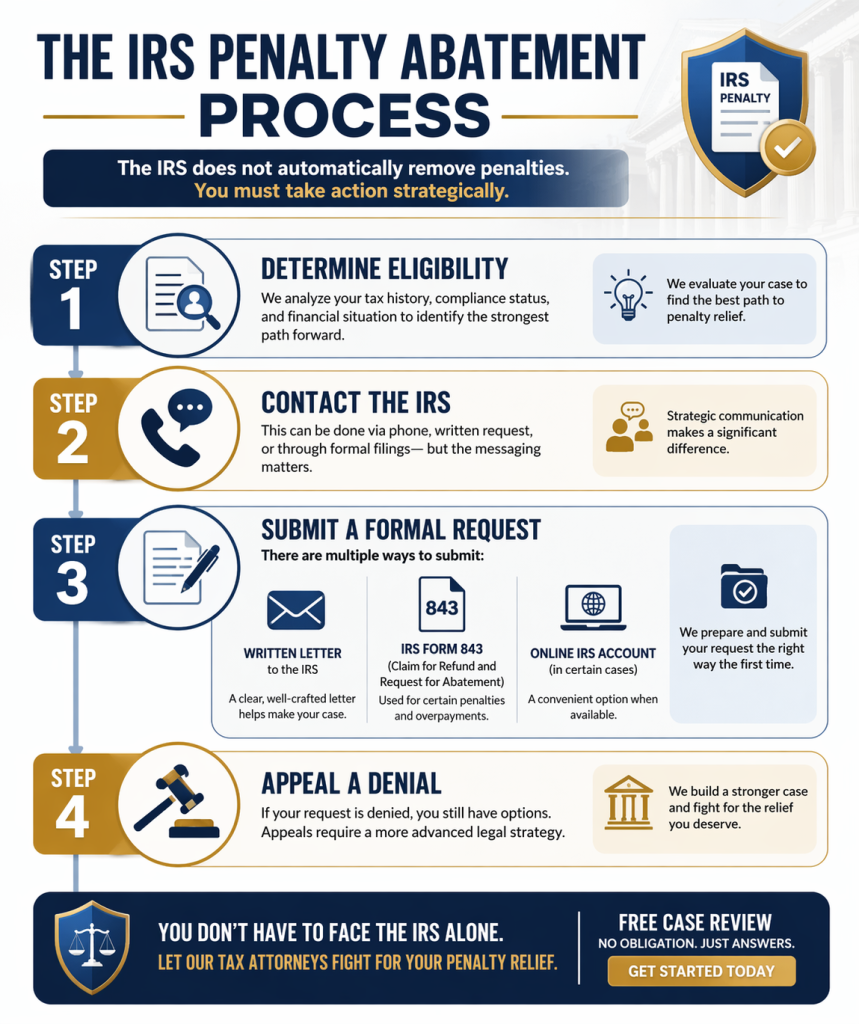
IRS Penalty Abatement Process
The IRS does not automatically remove penalties, you must take action strategically.
Step 1: Determine Eligibility
We analyze your tax history, compliance status, and financial situation to identify the strongest path forward.
Step 2: Contact the IRS
This can be done via phone, written request, or through formal filings, but the messaging matters.
Step 3: Submit a Formal Request
There are multiple ways to submit:
- Written letter to the IRS
- IRS Form 843 (Claim for Refund and Request for Abatement)
- Online IRS account (in certain cases)
Step 4: Appeal a Denial
If your request is denied, you still have options. Appeals require a more advanced legal strategy.
How IRS Penalty Relief Works
For reasonable cause cases, the IRS evaluates whether you acted responsibly but were prevented from complying.
Common qualifying situations include:
- Natural disasters or unexpected events
- Inability to access financial records
- Serious illness or family emergencies
- Extended absence or logistical challenges
- Financial hardship affecting basic living needs
It’s important to understand:
Simply not having money is not enough—unless it creates significant hardship and you made reasonable efforts to comply.
This is where professional strategy becomes critical.
Why Work With a Tax Attorney for IRS Penalty Abatement?
IRS penalty relief isn’t just paperwork, it’s legal positioning. A tax attorney brings:
- Legal authority in dealing with the IRS
- Experience in negotiation and appeals
- Ability to craft compelling “reasonable cause” arguments
- Protection against making costly mistakes
At Tax Law Advocates, you work directly with attorneys—not intermediaries—who understand how the IRS evaluates these cases.
Why Tax Law Advocates
We’re not a volume-based tax company—we’re a legal team focused on outcomes.
- 16+ years of experience in IRS resolution
- Attorney-led case strategy
- Nationwide representation
- Proprietary analysis tools
- Bilingual support available
- Transparent, ethical approach
Most importantly, we don’t take a one-size-fits-all approach. Every case is built strategically.
Real Client Scenarios
Case 1: First-Time Abatement Success
A client with $8,500 in penalties qualified for FTA. We handled the request, and the full penalty was removed within weeks.
Case 2: Medical Hardship Case
A taxpayer facing severe health issues had multiple penalties. We built a detailed reasonable cause narrative—resulting in substantial penalty reduction.
Case 3: IRS Error Correction
A client was penalized due to incorrect IRS processing. We escalated and secured a full reversal.
Meet Your Lead Tax Attorney and Enrolled Agent for IRS Debt Relief & Tax Resolution You Can Trust
David Cho
David Cho
Scott Mullerleile
EA with 12+ years in tax resolution and a background in collections. Scott has successfully handled hundreds of cases, including accepted Offers in Compromise and representation before Revenue Officers, audits, and appeals.
Our IRS Tax Relief Results by the Numbers
Proven results helping clients resolve IRS and state tax debt nationwide.
$0M+
Tax Debt Resolved for Clients
0K+
Clients served
0%
Handled by Tax Attorneys
0%
Cases Successfully Resolved
24hr
Average Case Action Time
0
Years of experience
Tax Law Advocates Client Success Stories
Jonnel Bolotano with Tax Law Advocates was amazing to work with. Even though I didn’t initially start my case with him, he stepped in, took charge, and stayed on top of everything from that point forward.
ItzMiBaebii
If I could give Tax Law Advocates more than 5 stars, I absolutely would. Jamie and Scott were my dream team, steady, sharp, and on top of every detail. I came in with a heavy tax burden that felt like it would follow me forever...
Rebecca Ingram
Jesse Moreno my tax lawyer did a wonderful job on my case. She was very patient kind and professional, and resolution that I received was better than I expected! Thank you Jesse for representing me!
Debbie Kern
FAQ
What is IRS penalty abatement?
It’s a process that allows taxpayers to reduce or eliminate IRS penalties under specific conditions.
Who qualifies for First-Time Penalty Abatement?
Taxpayers with a clean compliance history over the past 3 years.
Can I request penalty abatement myself?
Yes—but improper requests often get denied. Strategy matters.
How long does it take?
It varies from weeks to months depending on complexity and IRS response times.
Will interest also be removed?
In some cases, interest tied to removed penalties may also be reduced.
What penalties can be removed?
Common penalties include failure-to-file, failure-to-pay, and accuracy-related penalties.
What if my request is denied?
You can appeal with a stronger case strategy.
Does penalty abatement affect my tax debt?
It reduces penalties—not the original tax owed (unless part of a larger strategy).
Is this available nationwide?
Yes, IRS penalty abatement applies across the U.S.
Do I need a tax attorney?
Not required—but highly recommended for higher success rates.
