



IRS Hardship Program

Stop IRS Collections & Get Financial Relief Fast

$0M+

Tax Debt Resolved

Discover how much tax debt forgiveness you qualify for.

Your Name(Required)

If you’re struggling to keep up with IRS debt and basic living expenses, the IRS Hardship Program may give you the relief you need. When approved, it can pause IRS collections immediately, protecting you from levies, garnishments, and aggressive enforcement. But here’s what most people don’t realize:

  1. It’s not automatic
  2. It’s not permanent
  3. And how you apply can

determine whether you get approved or denied. That’s where strategy, and the right legal guidance, makes all the difference.

Senior couple relieved after qualifying for IRS Hardship Program to stop IRS collections and get financial relief

What Is the IRS Hardship Program?

The IRS Hardship Program, also known as Currently Not Collectible (CNC) status, is a form of relief that temporarily stops the IRS from collecting your tax debt. In simple terms, it tells the IRS:

“Right now, I genuinely cannot afford to pay without sacrificing basic living needs.”

If approved, the IRS will pause most collection actions. This means no bank levies, no wage garnishments, and no aggressive enforcement—giving you time to stabilize financially.

However, it’s important to understand that this does not erase your tax debt. The balance may continue to grow due to interest, and your financial situation will be reviewed periodically.

How Does the IRS Hardship Program Work?

Once you apply, the IRS evaluates your full financial picture. They look at your income, expenses, assets, and overall ability to pay.

If they determine that paying your tax debt would prevent you from covering essential expenses like housing, food, or medical care, they may place your account into hardship status.

When that happens, collections are paused—but your case doesn’t disappear. The IRS keeps your file active and may revisit it later.

This means the program is more like a pause button, not a permanent solution. That’s why how you structure your case—and what you do next—matters.

IRS Form 1040 tax documents with need help note highlighting the urgency of applying for IRS Hardship Program relief

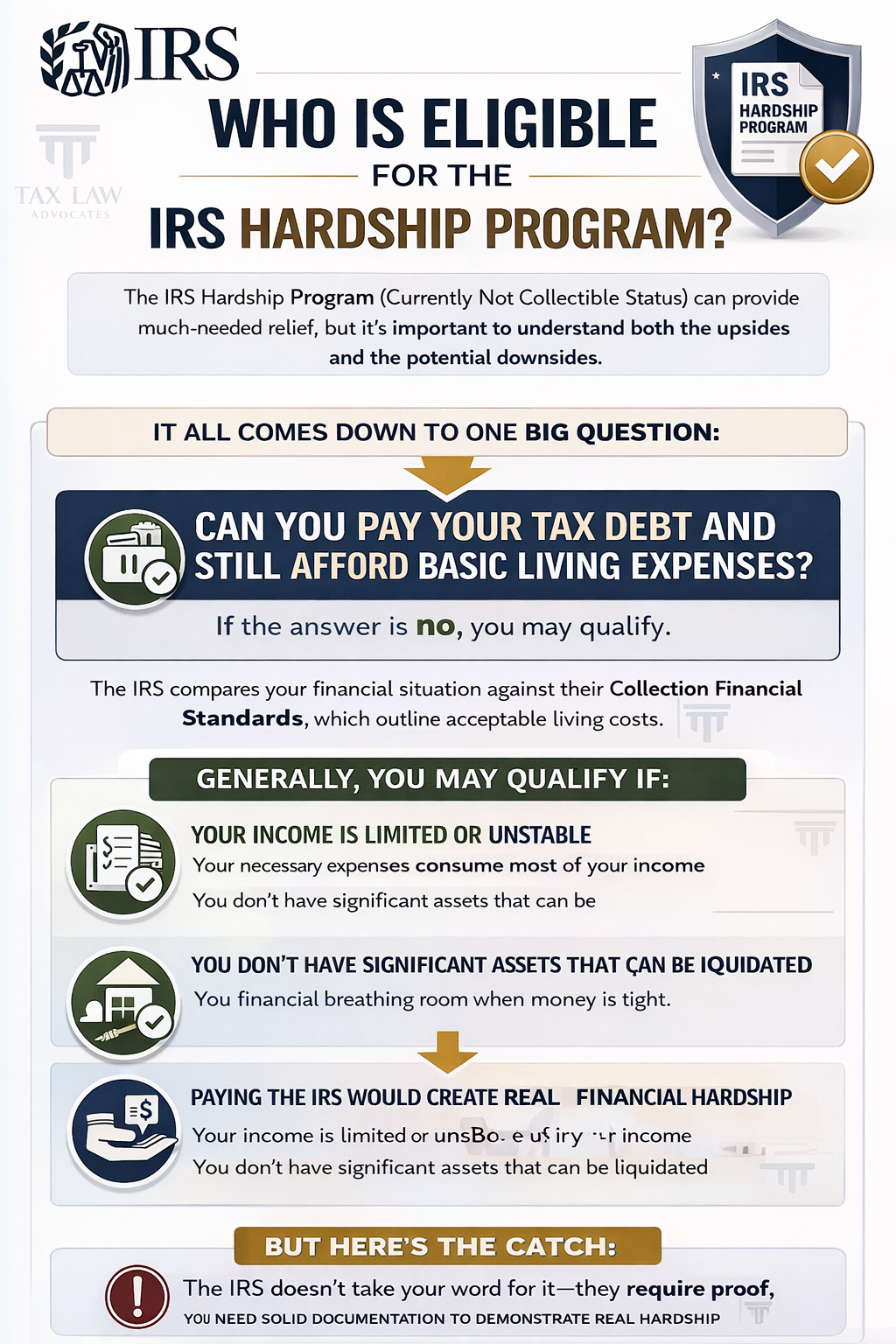
Who Is Eligible for the IRS Hardship Program?

Eligibility comes down to one core question:

Can you pay your tax debt and still afford basic living expenses?

If the answer is no, you may qualify. The IRS compares your financial situation against their Collection Financial Standards, which outline acceptable living costs.

Generally, you may qualify if:

  • Your income is limited or unstable
  • Your necessary expenses consume most of your income
  • You don’t have significant assets that can be liquidated
  • Paying the IRS would create real financial hardship

But here’s the catch:

The IRS doesn’t take your word for it, they require proof. That’s where many applications fail.

How to Apply and Qualify for IRS Hardship Program

Applying might seem straightforward, but this is where most people make costly mistakes. The process involves gathering financial documentation, completing disclosure forms, and submitting everything in a way that clearly demonstrates hardship.

The IRS reviews:

  • Your income vs. expenses
  • Your bank activity
  • Your assets
  • Your financial behavior

If your case isn’t clearly presented, the IRS may deny hardship status and push you toward a payment plan instead.

That’s why it’s not just about applying—it’s about positioning your case correctly from the start.

What is Form 911?

Form 911 is used to request help from the Taxpayer Advocate Service (TAS) an independent organization within the IRS. It’s typically used when you’re facing urgent financial hardship or when normal IRS processes aren’t resolving your issue. Think of it as an escalation tool when your situation needs immediate attention.

When Should I Use Form 911?

You should consider using Form 911 if your situation is urgent or not being handled properly through normal channels.

When your situation is affecting your ability to meet basic needs.

Such as a levy, garnishment, or asset seizure.

Delays can make things worse, especially when penalties continue to grow.

If your case is progressing normally or doesn’t involve urgent hardship, it may not be necessary.

Once submitted, a Taxpayer Advocate reviews your case and works directly with the IRS to resolve the issue faster.

Why Work with a Tax Attornry for IRS Hardship Program

This is where your outcome can change significantly. The IRS Hardship Program isn’t just about filling out forms, it’s about proving your case in a way the IRS accepts. A tax attorney brings:

  • Legal authority in dealing with the IRS
  • Deep understanding of IRS evaluation standards
  • Ability to structure financial disclosures strategically
  • Experience in handling denials and escalations

Most importantly: You’re not guessing, you’re building a case that works.

Why Tax Law Advocates

At Tax Law Advocates, we focus on outcomes—not volume.We combine legal expertise with real-world IRS negotiation experience to give clients the strongest chance of approval.

✔ 16+ years of experience
✔ Attorney-led representation
✔ Nationwide service
✔ Proven IRS negotiation success
✔ Transparent, ethical approach
✔ Bilingual support available

You’re not just another case—you’re a strategy.

Tax Attorney: David Cho

Tax Attorney David Cho leads tax resolution strategy at Tax Law Advocates with advanced expertise in IRS hardship programs and tax debt resolution. He earned both his J.D. and LL.M. in Taxation from the University of California, Irvine School of Law and works directly with the IRS to help clients facing wage garnishments, bank levies, and serious financial hardship.

Known for his practical, results-driven approach, David has helped clients pursue relief through programs such as Currently Not Collectible (CNC) status and Offer in Compromise settlements, helping individuals regain financial stability and move forward with confidence.

Real Client
Scenarios

One client came to us facing wage garnishment while struggling to pay rent. After reviewing their financials, we successfully positioned their case for hardship status, stopping collections immediately.Another client assumed they had no options. By restructuring their financial presentation, we demonstrated hardship and prevented enforcement actions.

In a third case, we combined hardship status with a long-term resolution strategy, giving the client both immediate relief and a path forward.

Meet Your Lead Tax Attorney and Enrolled Agent for IRS Debt Relief & Tax Resolution You Can Trust

David Cho

Tax attorney with a J.D. and LL.M. in Taxation from UCI Law. David focuses on practical tax resolution strategies, helping clients navigate IRS and state issues with clear, solution-driven guidance.

David Cho

Tax attorney with a J.D. and LL.M. in Taxation from UCI Law. David focuses on practical tax resolution strategies, helping clients navigate IRS and state issues with clear, solution-driven guidance.

Scott Mullerleile

EA with 12+ years in tax resolution and a background in collections. Scott has successfully handled hundreds of cases, including accepted Offers in Compromise and representation before Revenue Officers, audits, and appeals.

Scott Mullerleile

EA with 12+ years in tax resolution and a background in collections. Scott has successfully handled hundreds of cases, including accepted Offers in Compromise and representation before Revenue Officers, audits, and appeals.

Our IRS Tax Relief Results by the Numbers

Proven results helping clients resolve IRS and state tax debt nationwide.

$0M+

Tax Debt Resolved for Clients

0K+

Clients served

0%

Handled by Tax Attorneys

0%

Cases Successfully Resolved

24hr

Average Case Action Time

0

Years of experience

Tax Law Advocates Client Success Stories

Jonnel Bolotano with Tax Law Advocates was amazing to work with. Even though I didn’t initially start my case with him, he stepped in, took charge, and stayed on top of everything from that point forward.

ItzMiBaebii

If I could give Tax Law Advocates more than 5 stars, I absolutely would. Jamie and Scott were my dream team, steady, sharp, and on top of every detail. I came in with a heavy tax burden that felt like it would follow me forever...

Rebecca Ingram

Jesse Moreno my tax lawyer did a wonderful job on my case. She was very patient kind and professional, and resolution that I received was better than I expected! Thank you Jesse for representing me!

Debbie Kern

FAQ

It’s a program that pauses IRS collections when you cannot afford to pay.

No, it pauses collections but does not eliminate the debt.

It can last months or years, depending on your financial situation.

Yes, they review your situation periodically.

Yes, but improper applications are often denied.

Typically Form 433-F or 433-A.

No, interest may continue to accrue.

Not while in active CNC status.

You may need to pursue another resolution option.

Not required—but highly recommended.

Speak directly with a tax attorney. No obligation. Just real answers.