


IRS Installment Agreement

A Smarter Way to Pay Your Tax Debt Without the Pressure

$0M+

Tax Debt Resolved

Discover how much tax debt forgiveness you qualify for.

Your Name(Required)

If you’re dealing with IRS debt and can’t pay everything upfront, you’re not alone, and more importantly, you’re not out of options. The Internal Revenue Service actually offers structured payment plans called IRS installment agreements, designed to give you breathing room while staying compliant. But here’s what most people don’t realize…

Not all payment plans are created equal, and choosing the wrong one could mean paying more than you need to, for longer than necessary.

Client signing IRS Installment Agreement with tax attorney to pay tax debt in manageable monthly payments

What is an Installment Agreement (Form 9465)?

An IRS installment agreement is essentially a payment plan that allows you to pay off your tax debt over time instead of all at once.

Most people request it using Form 9465, although it can also be set up online or negotiated directly depending on your situation. At a basic level, it sounds simple, you owe taxes, and the IRS lets you pay monthly. But in reality, there’s more happening behind the scenes.

The IRS evaluates your financial situation, determines what they believe you can afford, and structures a plan accordingly. Without the right approach, that number can end up being higher than it should be.

Different Types of Installment Agreements

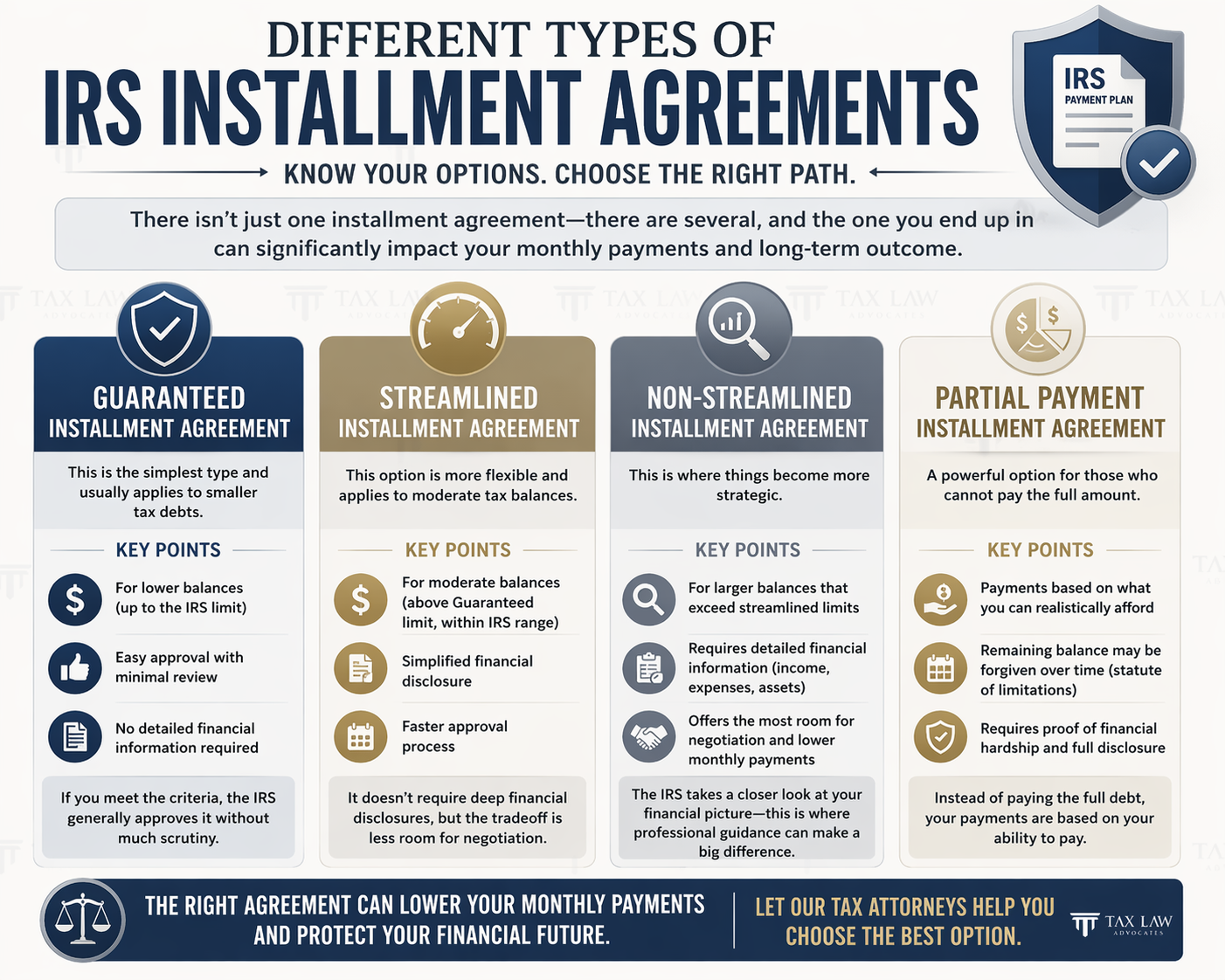
This is where things start to matter more than most people think. There isn’t just one installment agreement—there are several, and the one you end up in can significantly impact your monthly payments and long-term outcome.

Guaranteed Installment Agreement

This is the simplest type and usually applies to smaller tax debts. If you meet the criteria, the IRS generally approves it without much scrutiny.

Streamlined Installment Agreement

This option is more flexible and applies to moderate tax balances. It doesn’t require deep financial disclosures, but the tradeoff is less room for negotiation.

Non-Streamlined Installment Agreement

This is where things become more strategic. The IRS takes a closer look at your income, expenses, and assets, and this is exactly where professional guidance can make a big difference in lowering your monthly obligation.

Partial Payment Installment Agreement

This is one of the most powerful options available.Instead of paying the full debt, your payments are based on what you can realistically afford—and in some cases, a portion of the debt may never be collected.But getting into this type of agreement requires careful positioning.

How an IRS Installment Agreement Works

Once your agreement is approved, it becomes your structured path forward. You make monthly payments based on the agreed terms, and in most cases, the IRS pauses aggressive collection actions like levies or garnishments.

However, penalties and interest may still continue unless addressed strategically.That’s why this isn’t just about setting up payments, it’s about setting them up the right way. Because the IRS isn’t trying to minimize your payments, you are.

How to Apply for an Installment Plan

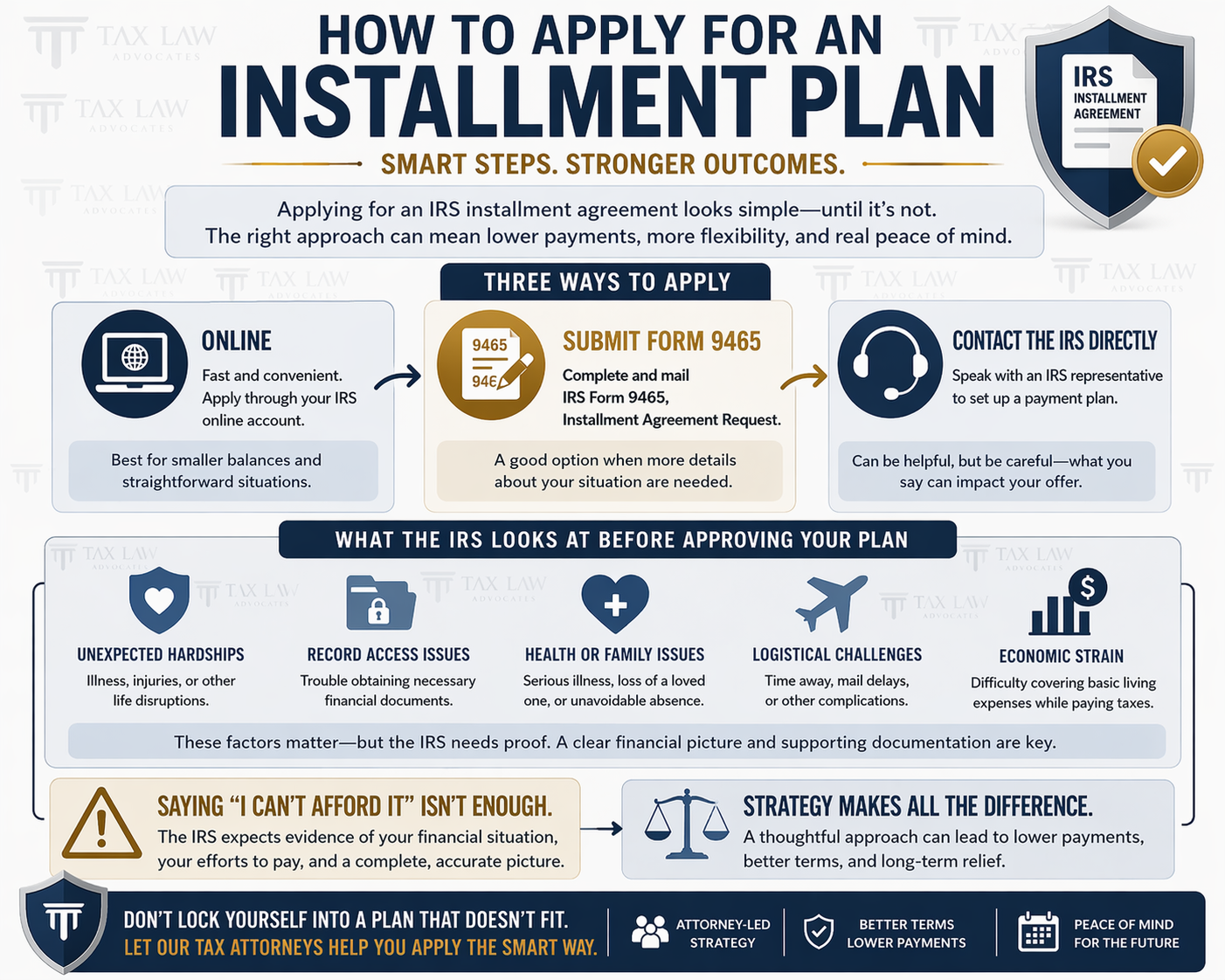
On the surface, applying looks straightforward. You can go online, submit Form 9465, or contact the IRS directly.  But here’s where many people unknowingly put themselves at a disadvantage. They apply quickly, accept the IRS’s terms, and lock themselves into a plan that doesn’t reflect their true financial situation. In reality, the IRS looks at a range of factors before approving a plan. They consider situations like unexpected hardships, health issues, difficulty accessing financial records, or economic strain that affects your ability to cover basic living expenses. At the same time, it’s important to understand that simply saying “I can’t afford it” isn’t enough. The IRS expects to see effort, documentation, and a clear financial picture. That’s where strategy—and sometimes legal representation—comes into play.

Why Work wit a Top TAX ATTORNEY for IRS Installment Agreement

This is the point where many cases either go in your favor—or against you.
A tax attorney doesn’t just submit paperwork. They understand how the IRS evaluates financial data, how to position your case, and how to negotiate terms that actually make sense for your situation.
They bring legal authority into the conversation, which can shift how your case is handled from the start. More importantly, they help ensure you’re not overpaying simply because you didn’t know your options.

Why Tax Law Advocates

At Tax Law Advocates, every IRS Installment Agreement case is built around strategy, not volume. With over 16 years of experience handling tax resolution matters, we create customized payment solutions based on each client’s financial situation and long-term goals. You won’t be passed around or treated like just another case file. Our team works directly with the IRS to negotiate installment agreements designed to reduce financial pressure while helping you stay compliant and protected. Through clear communication, transparency, and experienced guidance, we make sure you understand every step of the process and the options available to you.

Real Client Scenarios

One client came to us facing a monthly payment they simply couldn’t sustain. After reviewing their financials, we restructured their agreement and reduced the burden significantly. Another client assumed they had to pay their full balance. With the right strategy, we positioned them into a partial payment agreement that changed their long-term outlook completely.
In another case, we stepped in just before enforcement action and secured an agreement that stopped collections immediately. These aren’t unusual situations—they’re just situations handled correctly.

Meet Your Lead Tax Attorney and Enrolled Agent for IRS Debt Relief & Tax Resolution You Can Trust

David Cho

Tax attorney with a J.D. and LL.M. in Taxation from UCI Law. David focuses on practical tax resolution strategies, helping clients navigate IRS and state issues with clear, solution-driven guidance.

David Cho

Tax attorney with a J.D. and LL.M. in Taxation from UCI Law. David focuses on practical tax resolution strategies, helping clients navigate IRS and state issues with clear, solution-driven guidance.

Scott Mullerleile

EA with 12+ years in tax resolution and a background in collections. Scott has successfully handled hundreds of cases, including accepted Offers in Compromise and representation before Revenue Officers, audits, and appeals.

Scott Mullerleile

EA with 12+ years in tax resolution and a background in collections. Scott has successfully handled hundreds of cases, including accepted Offers in Compromise and representation before Revenue Officers, audits, and appeals.

Our IRS Tax Relief Results by the Numbers

Proven results helping clients resolve IRS and state tax debt nationwide.

$0M+

Tax Debt Resolved for Clients

0K+

Clients served

0%

Handled by Tax Attorneys

0%

Cases Successfully Resolved

24hr

Average Case Action Time

0

Years of experience

Tax Law Advocates Client Success Stories

Jonnel Bolotano with Tax Law Advocates was amazing to work with. Even though I didn’t initially start my case with him, he stepped in, took charge, and stayed on top of everything from that point forward.

ItzMiBaebii

If I could give Tax Law Advocates more than 5 stars, I absolutely would. Jamie and Scott were my dream team, steady, sharp, and on top of every detail. I came in with a heavy tax burden that felt like it would follow me forever...

Rebecca Ingram

Jesse Moreno my tax lawyer did a wonderful job on my case. She was very patient kind and professional, and resolution that I received was better than I expected! Thank you Jesse for representing me!

Debbie Kern

FAQ

It’s a payment plan that allows you to pay your tax debt over time instead of all at once.

You can apply online, submit Form 9465, or work with a tax professional.

In most cases, yes. Approval typically pauses aggressive actions.

Yes, especially in more complex agreements where financial review is involved.

Yes, although strategies may reduce the overall impact.

Your agreement could default, and IRS enforcement may resume.

Yes, but it may require more detailed financial documentation.

It’s the official IRS form used to request a payment plan.

Yes, and doing so can reduce interest costs.

Not required—but often the difference between a basic plan and a strategic one.

Speak directly with a tax attorney for IRS Installment Agreement . No obligation. Just real answers.