



IRS Debt Forgiveness

That Reduces What You Owe and Gives You a Fresh Financial Start

$0M+

Tax Debt Resolved

Discover how much tax debt forgiveness you qualify for.

Your Name(Required)

What Is IRS Debt Forgiveness?

IRS debt forgiveness refers to the various programs the IRS offers that allow eligible taxpayers to resolve their outstanding tax liability for less than the full amount owed. It is not a blanket cancellation of debt, but rather a formal process through which the IRS acknowledges that collecting the full balance is either not feasible or not in the best interest of both parties.

Programs like the Offer in Compromise, penalty abatement, and Currently Not Collectible status all fall under the broader umbrella of IRS debt forgiveness. Each program has specific eligibility requirements and requires thorough documentation to pursue successfully.

Why Do People Need IRS Debt Forgiveness Help?

Many taxpayers assume that the full amount the IRS says they owe is final and non-negotiable. That is not the case. The IRS has established formal programs specifically designed to resolve tax debt that a taxpayer genuinely cannot pay in full, but navigating those programs without professional help is extremely difficult.

The IRS has the authority to:

IRS debt forgiveness programs exist to provide real relief, but only when pursued correctly with full documentation and proper legal representation.

Common Problems IRS Debt Forgiveness Resolution Handles

Pursuing IRS debt forgiveness without professional guidance leads to a range of serious problems. Rejected Offer in Compromise applications are extremely common among self-represented taxpayers, often due to incomplete financial disclosures or incorrectly calculated offer amounts. Misidentification of the right forgiveness program results in wasted time and continued collection activity while the wrong application is being processed. Incomplete documentation causes delays that allow penalties and interest to keep growing on the outstanding balance. Our attorneys evaluate your complete financial situation, identify the right program, and build a properly documented case that gives you the strongest possible chance of a successful outcome.

An Example of IRS Debt Forgiveness

Consider a retail store owner whose business failed during an economic downturn, leaving behind $175,000 in combined federal income and payroll tax debt. With no business income, limited personal assets, and no realistic ability to repay the full balance, the situation felt permanent. A Tax Law Advocates attorney conducted a thorough financial analysis, determined the client qualified for an Offer in Compromise, and submitted a fully documented application with a calculated offer amount based on the client’s true ability to pay. The IRS accepted the offer and the entire $175,000 liability was resolved for significantly less, giving the client a genuine fresh start.

Who Is Eligible for IRS Debt Forgiveness in 2026?

Eligibility for IRS debt forgiveness is based on your financial situation, your compliance history, and the specific program being pursued. 

You may qualify if:

  • You owe federal tax debt that you cannot realistically pay in full
  • Your income and assets do not support full repayment within the collection statute
  • You have experienced a significant financial hardship such as job loss, illness, or business failure
  • All required tax returns have been filed or can be brought current
  • You are not currently in an open bankruptcy proceeding

The IRS uses a specific formula to evaluate ability to pay when considering forgiveness applications. A tax attorney ensures your financials are presented accurately to give you the best possible result.

Pros, Cons & What the IRS Says

The Truth About IRS Debt Forgiveness

The greatest advantage of IRS debt forgiveness is the possibility of resolving a tax liability that would otherwise follow you for years at a fraction of the total amount owed. For taxpayers who genuinely qualify, it represents a real and lasting solution. The challenge is that forgiveness programs are not available to everyone and the qualification process is strict. The IRS approves a relatively small percentage of Offer in Compromise applications submitted without professional representation. The IRS openly acknowledges these programs and supports their use for taxpayers who meet the criteria, but proper documentation and accurate financial disclosure are absolutely non-negotiable.

What IRS Debt Forgiveness Options Are Available to Me?

Several formal IRS programs fall under the category of debt forgiveness depending on your situation.

An Offer in Compromise allows you to settle your total tax liability for less than the full amount owed based on your demonstrated ability to pay. Penalty Abatement removes penalties from your total balance where reasonable cause or first time abatement criteria are met, often resulting in significant debt reduction. Currently Not Collectible status formally pauses all collection activity when your financial situation makes any payment impossible, giving you time to stabilize. In certain cases, the Collection Statute Expiration Date strategy allows an attorney to manage your case until the IRS legal window to collect expires entirely.

How to Apply for IRS Debt Forgiveness in 2026?

Applying for IRS debt forgiveness requires careful preparation and complete financial transparency. You will need to:

  • File all missing federal tax returns to establish full compliance
  • Complete IRS financial disclosure forms detailing all income, expenses, assets, and liabilities
  • Identify the correct forgiveness program based on your financial profile
  • Submit a properly structured and fully documented application to the IRS

An improperly submitted application can be rejected outright and reset the clock on your case, allowing collection action to continue. Getting it right the first time is critical.

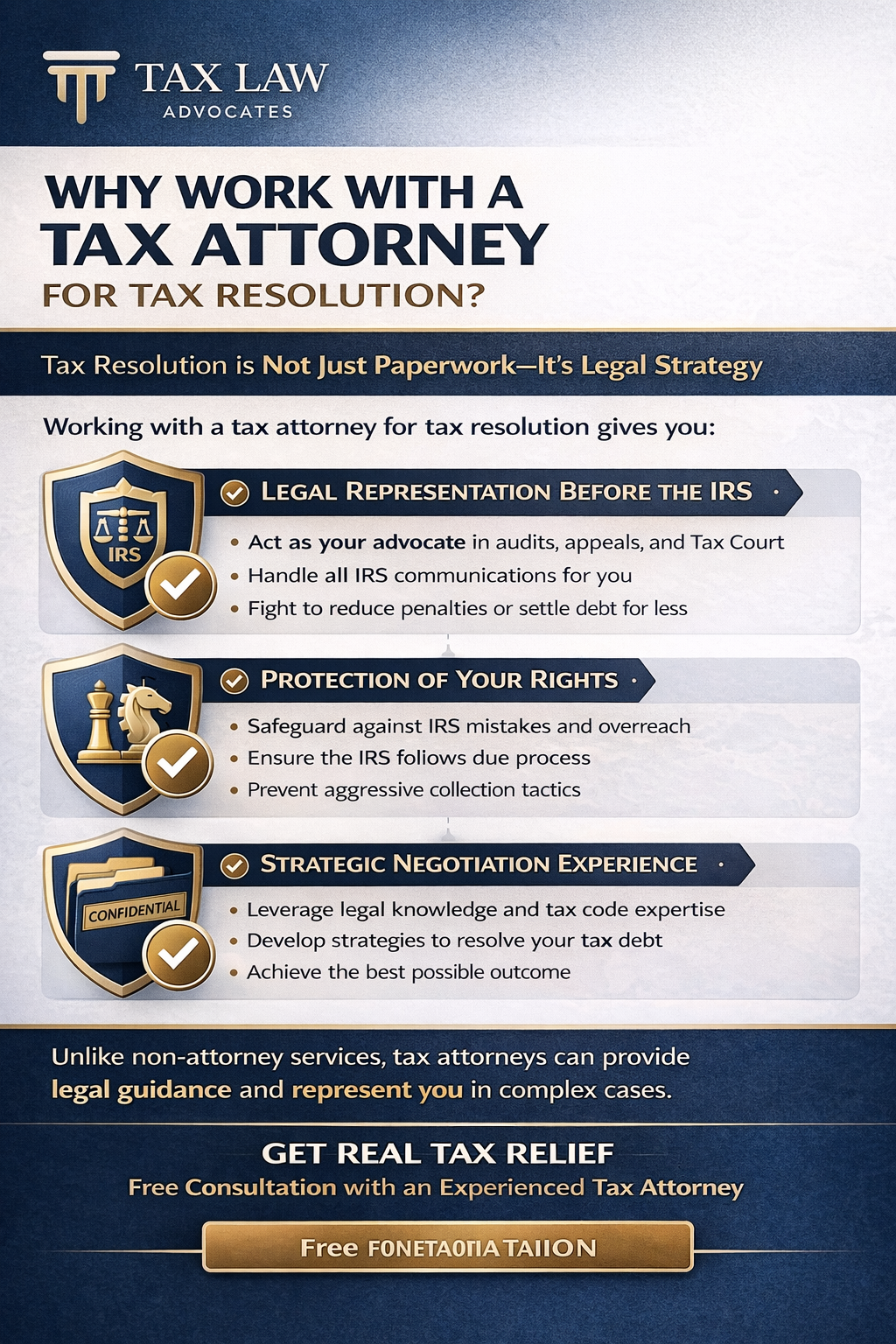
Why Work With a Tax Attorney for IRS Debt Forgiveness?

IRS debt forgiveness is one of the most complex and high stakes areas of tax resolution. The difference between an approved and rejected application often comes down to how the financials are presented and whether the right program was pursued in the first place. Working with a tax attorney gives you:

  • Expert evaluation of which forgiveness program you actually qualify for
  • Accurate and complete financial disclosure that meets IRS requirements
  • Legal representation throughout the entire application and negotiation process
  • Protection from collection action while your forgiveness case is being processed

Tax Law Advocates has helped clients resolve millions of dollars in IRS tax debt through forgiveness programs. We know what the IRS looks for, we know how to build a winning case, and we fight to get you the best possible outcome.

Meet Your Lead Tax Attorney and Enrolled Agent for IRS Debt Relief & Tax Resolution You Can Trust

David Cho

Tax attorney with a J.D. and LL.M. in Taxation from UCI Law. David focuses on practical tax resolution strategies, helping clients navigate IRS and state issues with clear, solution-driven guidance.

David Cho

Tax attorney with a J.D. and LL.M. in Taxation from UCI Law. David focuses on practical tax resolution strategies, helping clients navigate IRS and state issues with clear, solution-driven guidance.

Scott Mullerleile

EA with 12+ years in tax resolution and a background in collections. Scott has successfully handled hundreds of cases, including accepted Offers in Compromise and representation before Revenue Officers, audits, and appeals.

Scott Mullerleile

EA with 12+ years in tax resolution and a background in collections. Scott has successfully handled hundreds of cases, including accepted Offers in Compromise and representation before Revenue Officers, audits, and appeals.

Our IRS Tax Relief Results by the Numbers

Proven results helping clients resolve IRS and state tax debt nationwide.

$0M+

Tax Debt Resolved for Clients

0K+

Clients served

0%

Handled by Tax Attorneys

0%

Cases Successfully Resolved

24hr

Average Case Action Time

0

Years of experience

Tax Law Advocates Client Success Stories

Jonnel Bolotano with Tax Law Advocates was amazing to work with. Even though I didn’t initially start my case with him, he stepped in, took charge, and stayed on top of everything from that point forward.

ItzMiBaebii

If I could give Tax Law Advocates more than 5 stars, I absolutely would. Jamie and Scott were my dream team, steady, sharp, and on top of every detail. I came in with a heavy tax burden that felt like it would follow me forever...

Rebecca Ingram

Jesse Moreno my tax lawyer did a wonderful job on my case. She was very patient kind and professional, and resolution that I received was better than I expected! Thank you Jesse for representing me!

Debbie Kern

FAQ

They are professional services that help resolve tax debt through negotiation and IRS programs.

Yes, in some cases through programs like Offer in Compromise.

It depends on your income, assets, and financial hardship.

It varies from weeks to several months depending on the case.

In some cases, actions can be paused once representation begins.

It’s highly recommended for complex or high-value cases.

Yes, through penalty abatement if you qualify.

Yes, services are available in all 50 states.

You may qualify for hardship status.

Yes, initial case reviews are free.

Speak directly with a tax attorney. No obligation. Just real answers.